
Trees Near Foundations
Learn about Trees Near Foundations, what should you do?
6/5/20267 min read
Trees Near Foundations:
Homeowners Should Know
Trees can make a home look warm, green, and welcoming. They give shade in summer, support birds and wildlife, improve gardens, and can make a property feel more private. Many people like having mature trees near their home because they add beauty and character.
However, when a tree is close to a house, it is wise to understand how it may affect the ground and the building over time. A tree near a house does not always mean there is a problem. Many trees and homes stand safely together for many years. The risk depends on several things, such as the type of soil, the size of the tree, the type of tree, the depth of the foundations, the age of the house, and how well the drains work.
The aim is not to fear trees. The aim is to understand the risks early and deal with them in a careful and balanced way.
Trees Near Homes Can Be a Concern
The main problem is usually not that tree roots push through strong foundations. In most cases, roots do not break through solid concrete foundations by force. The bigger concern is the way trees take water from the soil.
Tree roots grow through the ground to find water and food. During dry weather, large trees can take a lot of water from the soil. This can be a problem if the house is built on clay soil.
Clay soil can shrink when it becomes dry. It can also swell when it becomes wet again. This movement can affect a building if it happens under or near the foundations. If one part of the ground moves more than another part, the foundation may move unevenly. This can lead to cracks, gaps, sticking doors, or uneven floors.
This type of ground movement is often called subsidence. Subsidence means that the ground under a building has moved down. When this happens unevenly, parts of the building may move too.
Soil Type
Not all soil acts in the same way. Sandy or gravelly soil usually drains more freely and does not shrink and swell as much as clay. Clay soil is different because it holds water. When clay is wet, it can expand. When clay dries out, it can shrink.
This is why trees can be more of a risk on clay soil. A large tree can remove water from the clay, especially during long dry periods. If the clay dries and shrinks near the foundation, the building may move.
The risk is usually higher when all these things happen together:
· The soil is shrinkable clay.
· The tree is large or mature.
· The tree is close to the house.
· The foundations are shallow.
· The weather has been dried for a long time.
· The building is older or has already moved before.
This does not mean every tree on clay soil is dangerous. It simply means the site should be checked carefully.
Tree Size and Type
Some trees take more water from the ground than others. Fast-growing and large trees often need more water. Examples can include willow, poplar, oak and elm trees. These trees can have wide root systems and high-water needs. Smaller trees and shrubs may carry less risk, but they still need to be considered if they are very close to the house or drains. Tree size also matters. A young tree may not cause much change at first, but it may become a bigger issue as it grows. A mature tree already has a larger root system and may take more water from the soil.
The distance between the tree and the building is important too. A tree very close to a house may carry more risk than a tree at the far end of the garden. However, distance alone is not the only thing to think about. Soil type, tree type, foundation depth, and drainage are also important.
Foundations and Older Homes
The depth and type of foundation can affect how much risk there is. Modern houses are often built with deeper foundations, especially where trees and clay soil are known concerns. Older houses may have shallower foundations because building rules and methods were different in the past.
A shallow foundation may be more affected by soil movement near the surface. If the soil dries and shrinks, the foundation may not have enough depth to stay stable.
Extensions can also be affected. Sometimes the main house and the extension were built at different times, with different foundation depths. If the ground moves, the join between the old and new parts of the building may crack.
This is why cracks near extensions should be watched carefully. They do not always mean serious damage, but they should not be ignored if they grow or appear suddenly.
Common Warning Signs
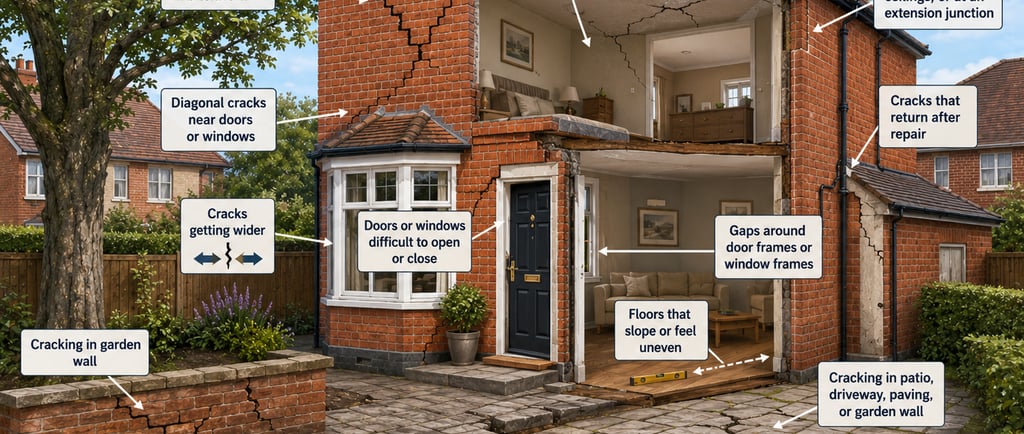
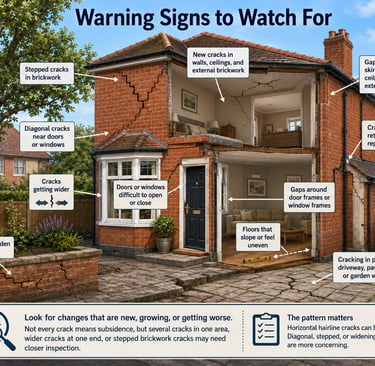
Homeowners should look for changes that are new, growing, or getting worse. Small cracks are common in many homes. They can happen because of age, normal settlement, temperature changes, old repairs, or poor workmanship. Not every crack means subsidence.
However, some signs should be taken seriously, especially if they appear near trees or get worse in dry weather.
Common warning signs include:
· New cracks in walls, ceilings, or outside brickwork.
· Cracks that are getting wider.
· Diagonal cracks near doors or windows.
· Doors or windows becoming hard to open or close.
· Gaps around door frames or window frames.
· Gaps near skirting boards, ceilings, or extensions.
· Floors that feel uneven or seem to slope.
· Cracking in patios, driveways, paving, or garden walls.
· Cracks that return after being repaired.
The pattern of cracking matters. One small hairline crack may not be serious. But several cracks in the same area, cracks that are wider at one end, or cracks that follow a stepped pattern in brickwork may need closer inspection.
Drains Are Important
Drains can also play a big part in foundation problems. Tree roots may enter drains if the drains are already cracked or leaking. Roots are drawn to water, so a damaged drain can attract them. Once roots enter a drain, they can make the damage worse. They may block the pipe, cause leaks, or allow more water to escape into the soil. This can soften the ground or wash fine soil away. In some cases, this can lead to movement near the building. Drainage problems can also be mistaken for tree-related subsidence. For example, a leaking drain can cause ground movement even when the tree is not the main cause. This is why a proper inspection should look at the whole site. It should not only look at the tree. It should also consider the drains, soil, foundations, cracks, paving, and history of the building.
Do Not Rush to Remove a Tree
If cracks appear near a tree, some homeowners may think the best answer is to cut the tree down. This is not always the right step. Removing a tree can sometimes help, but it can also cause new problems. If a tree has been taking water from clay soil for many years, removing it can allow the soil to become wetter again. The clay may then swell. This upward movement is sometimes called heave. Heave can also damage a building, especially if the foundations are shallow. This is why tree removal should be planned carefully. Before removing a large tree, it is best to get advice from a structural engineer, arborist, or another suitable professional. They can help decide whether the tree is really causing the problem and what action is safest. In some cases, pruning may be suggested. In other cases, drain repairs, monitoring, or foundation work may be needed. Every property is different, so the right answer depends on the site.
Tree Preservation Orders and Conservation Areas
Some trees are legally protected. A tree may have a Tree Preservation Order, often called a TPO, or it may be located within a conservation area. TPO trees usually need council consent before any cutting, pruning or removal. Conservation-area trees usually require six weeks’ notice to the local council before work begins. Always check with your local planning authority before carrying out tree work.
How can we Reduce the Risk
There are simple steps that can help reduce the risk of tree-related foundation problems.
Know what type of soil is under your home. If the property is on shrinkable clay, be more careful with large trees near the building.
Keep drains in good condition. Repair leaks quickly. If there are signs of blocked drains, bad smells, damp ground, or repeated drainage issues, arrange a drain survey.
Watch cracks over time. Take dated photos and measure the width of cracks if you can. This helps show whether the cracks are stable or getting worse.
Avoid planting large, high-water-demand trees too close to the house. When planting new trees, think about how big they will become, not just how small they are now.
Get advice before cutting down mature trees near buildings. Sudden changes can sometimes cause more ground movement.
Keep gutters and rainwater pipes working well. Water should flow away from the building properly. Broken gutters can soak the ground near foundations and cause other problems.
Ask for Professional Help
You should seek professional help if you see cracks that are growing, doors or windows that start sticking, floors that become uneven, or gaps opening around frames or skirting boards.
You should also ask for advice if you are buying a house with large trees close to it. A survey can help you understand the risk before you buy.
A structural inspection may include looking at the cracks, checking the pattern of movement, considering nearby trees, reviewing the soil type, and checking whether drains may be involved. Sometimes monitoring is needed over a period of time. This can show whether the building is still moving or whether the movement has stopped.
Professional advice can stop homeowners from taking the wrong action. It can also help avoid unnecessary worry and costly repairs.
Final Thoughts
Trees are valuable. They should not be treated as a problem just because they are near a house. In many cases, trees and buildings can exist safely together. The highest risk is usually where a large tree with high water needs is close to shallow foundations on shrinkable clay soil. The risk can be higher during long dry periods, especially if there are also drainage problems. Homeowners should stay aware but not panic. Look for signs of movement, keep drains in good condition, and ask for advice if cracks or other warning signs appear. Early checks can make a big difference. They can help find the real cause, reduce repair costs, and protect both the home and the tree where possible.
REFERENCES
Royal Horticultural Society (RHS). “Trees near buildings.”
National House Building Council (NHBC). “Chapter 4.2: Building near trees.” NHBC Standards, 2024.
British Geological Survey (BGS). “GeoSure: shrink–swell.”
Association of British Insurers (ABI). “Subsidence.”
GOV.UK. “Tree Preservation Orders and trees in conservation areas.” 2014.