
Structural Engineer for Load-Bearing Wall Removal
Structural Engineer for Load-Bearing Wall Removal
6/24/20266 min read
Structural Engineer for Load-Bearing Wall Removal
Removing a load-bearing wall is one of the most popular ways to improve an older home. It can turn separate kitchens, dining rooms and living rooms into a larger open-plan space, improve natural light and make the property more practical for modern family life.
However, removing a wall is not simply a demolition job. If the wall supports floor joists, roof structure, masonry above, a chimney breast or other parts of the building, it must be replaced with a properly designed structural support. This is where a structural engineer for load-bearing wall removal is essential.
A structural engineer assesses how the existing building works, calculates the loads being carried and designs a safe replacement structure. The design may include a steel beam, timber beam, flitch beam, columns, padstones or upgraded supports below. The final solution depends on the property, opening size and loads involved.
A load-bearing wall transfers weight from the structure above down through the building to the foundations. In many traditional houses, internal masonry walls support floor joists, walls above or roof members.
Some common signs that a wall may be load-bearing include:
It runs across the width of the house rather than parallel to the floor joists.
There is another wall directly above it on the first floor.
Ceiling or floor joists appear to bear onto the wall.
It sits beneath a chimney breast or support to the roof structure.
It is made from masonry rather than lightweight studwork.
These signs are only indicators. They do not replace a proper inspection. Older properties often have altered layouts, concealed steelwork, previous extensions or unusual timber framing. A wall that looks like a simple partition can sometimes support important parts of the house.
Before any demolition starts, a structural engineer should inspect the wall, review the layout and identify what is being supported.
A structural engineer for load-bearing wall removal provides the technical design needed to remove the wall safely and satisfy Building Control.
The process usually starts with a site visit or detailed review of drawings, photographs and measurements. The engineer will identify the wall, measure the proposed opening and assess the structure above. This can include floor joists, roof loads, external walls, chimney loads and any existing beams.
The engineer will then prepare structural calculations and drawings. These normally show:
The size and specification of the proposed beam.
The required bearings at each end of the beam.
Padstone or bearing details where required.
Posts, columns or strengthened walls below where necessary.
Connection and restraint details.
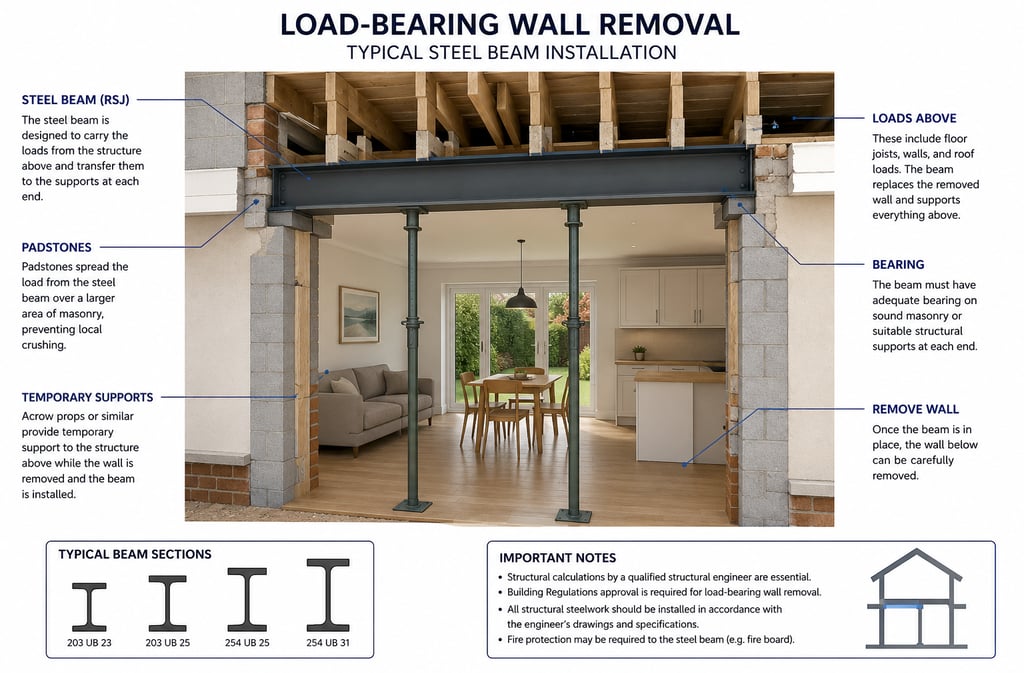
Temporary support requirements for the contractor.
Notes for Building Control and construction.
The beam is not designed only for the opening itself. It must safely transfer all loads from above into suitable supports and ultimately down to the foundations. This is why a beam cannot be selected based only on the width of the opening.
In many house renovations, a steel universal beam is used because it can carry high loads over a relatively shallow depth. Steel is often suitable where there is a wide opening, masonry above, floor loads or roof loads to support.
However, steel is not always the only option. Some projects may use engineered timber, a flitch beam or smaller structural members depending on the required span, headroom, fire protection and architectural finish.
The right solution depends on the project. A structural engineer considers the loading, span, available depth, support conditions and construction method before choosing the beam type.
It is important not to assume that a larger beam is automatically safer. Oversized steel can create unnecessary cost, installation difficulty and additional load on the supports below. The correct beam is one that is properly designed for the specific property.
Before a load-bearing wall is removed, the structure above must be supported temporarily. This is often carried out using steel props, strongboys, needles, temporary timber supports or another method suitable for the property.
Temporary works are critical because the building can move or crack if floors, walls or roof members are unsupported during the installation. The contractor must follow the structural drawings and use a safe method of work.
The final beam should only take over once it has been installed correctly, packed, restrained and supported at both ends. Existing masonry should never be removed without understanding what it supports.
For complex alterations, especially where several walls are being removed or there are poor existing conditions, a more detailed temporary works approach may be required.
Removing a load-bearing wall is a structural alteration. A Building Control application is normally required before work starts.
Building Control will usually expect structural calculations and drawings from a competent structural engineer. The inspector may check the beam size, bearings, padstones, connection details, fire protection and workmanship during the project.
The project may also affect other Building Regulations requirements. For example, the work could affect:
Fire escape routes within the home.
Smoke alarm requirements.
Ventilation to kitchens or bathrooms.
Electrical works and certification.
Drainage or plumbing alterations.
Thermal insulation where external walls are changed.
Planning permission is often not required for straightforward internal alterations, but this is separate from Building Regulations. Listed buildings, flats, conservation areas and larger refurbishment projects may have additional requirements. Always check the position for your own property before starting work.
Padstones are used where the end reaction from a beam is too high for the existing brickwork or blockwork to support directly. They spread the beam load over a larger area and reduce the risk of local crushing.
The need for a padstone depends on the beam reaction, wall material, wall condition and the support below. Some projects require concrete padstones, while others may need engineered steel plates, new masonry piers, posts or upgraded supports.
A structural engineer will specify the appropriate bearing arrangement. The builder should not simply install a generic padstone without checking whether it is suitable for the beam and existing wall.
A common mistake is to focus only on the new beam. The supports below are equally important.
If a beam bears onto an internal wall, that wall may transfer the load to a ground-floor beam, wall, foundation or existing padstone below. In a two-storey house, removing a ground-floor wall may affect the first-floor structure and the foundations.
The structural engineer must assess the full load path. In some cases, the design may need a steel post, masonry pier, foundation check or additional support at lower level.
This is particularly important in older terraced properties, where walls may be thin, altered over time or built on shallow foundations.
Do not remove the wall before obtaining structural advice. Do not rely on a builder’s visual opinion alone where the wall may carry significant load. Do not choose an RSJ from an online table without considering the property, load path and support conditions.
Other common issues include inadequate bearings, missing padstones, poor packing beneath steel, lack of fire protection, insufficient temporary support and failure to notify Building Control.
These problems can lead to cracking, deflection, costly remedial work, delays with Building Control and difficulties when selling or remortgaging the property.
Choose an engineer who understands residential alterations and can provide clear, practical information for both Building Control and the contractor.
Before appointing an engineer, ask what is included. A good service should clearly explain whether it includes a site visit, structural calculations, drawings, Building Control notes and support during construction queries.
For a simple opening, the design process can be straightforward. For wider openings, chimney removals, rear extensions, loft conversions or multiple wall removals, the design needs more coordination.
Final Thoughts
A structural engineer for load-bearing wall removal helps ensure your project is safe, buildable and compliant. The purpose is not simply to specify a steel beam. It is to understand the whole structure, design the correct load path and provide clear information for Building Control and the builder.
Removing a wall can transform your home, but the work should always start with the right structural advice. Proper design at the beginning helps avoid unnecessary risk, delays and expensive alterations later.
For structural calculations, drawings and Building Control support for load-bearing wall removal, contact Reno Consulting LTD.
REFERENCES
GOV.UK. Building Regulations Approval: When You Need Approval. Guidance on when Building Regulations approval may be required for building work and structural alterations in England.
Ministry of Housing, Communities and Local Government. Approved Document A: Structure. Statutory guidance relating to structural safety, including foundations, walls, floors, roofs and chimneys.
Planning Portal. Building Regulations: Load-Bearing Walls – Internal Walls. Guidance on identifying walls that may support roof structures, walls above or floor joists.
Planning Portal. Do I Need Building Control Approval to Remove All or Part of an Internal Wall? Guidance on Building Control considerations and obtaining structural advice before alteration work.
Planning Portal. Internal Walls: Planning Permission. Guidance explaining that internal alterations do not normally require planning permission, subject to circumstances such as listed buildings.
London Borough of Redbridge Building Control. Removing Load-Bearing Walls. Guidance on Building Regulations consent and the role of structural engineers in designing beams and supporting structures.